
Startup Ecosystem Platforms: What They Are, the Main Types, and How to Choose One
If you run an accelerator, advise a city government, or manage a corporate innovation unit, you have probably been told you need a “startup ecosystem platform.” The phrase is used confidently by vendors and almost never defined the same way twice. One company selling you a platform means a searchable database of every startup in your region. Another means the software that processes cohort applications and matches mentors. A third means a community network where founders, angels and corporates find each other. All three are real products, all three are legitimately called startup ecosystem platforms, and buying the wrong one is how organisations end up with an expensive tool that answers a question nobody asked.
This guide separates the categories, explains what each actually does, shows what the leading platforms cost, and gives you a way to decide which type your ecosystem needs before you sit through a single sales demo.
What a startup ecosystem platform actually is
A startup ecosystem platform is software that makes the relationships inside an entrepreneurial ecosystem visible and manageable. That is the honest common denominator across every product in the category. Left alone, an ecosystem is a loose collection of founders, funds, accelerators, universities, service providers and public agencies who each hold a fragment of the picture. The accelerator knows its own cohort. The economic development agency knows which grants were disbursed. The angel network knows its own deal flow. Nobody holds the whole map, and nobody can prove what the ecosystem collectively produced last year.
A platform closes that gap in one of two directions. It either aggregates the data so the ecosystem can be measured, benchmarked and shown to outsiders, or it runs the workflows so the ecosystem’s programs stop living in spreadsheets, email threads and disconnected SaaS subscriptions. The best platforms now attempt both, which is why the category boundaries have blurred and why buyers get confused.
How this differs from a startup ecosystem itself
It is worth being precise, because the two terms get used interchangeably and they are not the same thing. A startup ecosystem is the network itself: founders, startups at various stages, capital providers, accelerators and incubators, universities and research institutions, service providers, and government bodies, all interacting within a shared geography or sector. Startup Genome frames it geographically, describing an ecosystem as a shared pool of resources generally located within a sixty-mile or hundred-kilometre radius of a central point. Others define it more loosely to include virtual and sector-based networks. Innoloft’s framing is useful here, splitting ecosystems into local or regional hubs, industry-specific systems such as fintech or health tech, global cross-border networks, and hybrid or remote-first communities held together by digital tools.
The ecosystem is the thing. The platform is the instrumentation layer on top of it. A platform cannot create an ecosystem that does not exist, and this is the single most common disappointment among first-time buyers, particularly in public-sector procurement where a software purchase is sometimes mistaken for an ecosystem strategy.
The three types of startup ecosystem platforms
Almost every product marketed under this label belongs to one of three families. Knowing which family you are shopping in eliminates most of the noise.
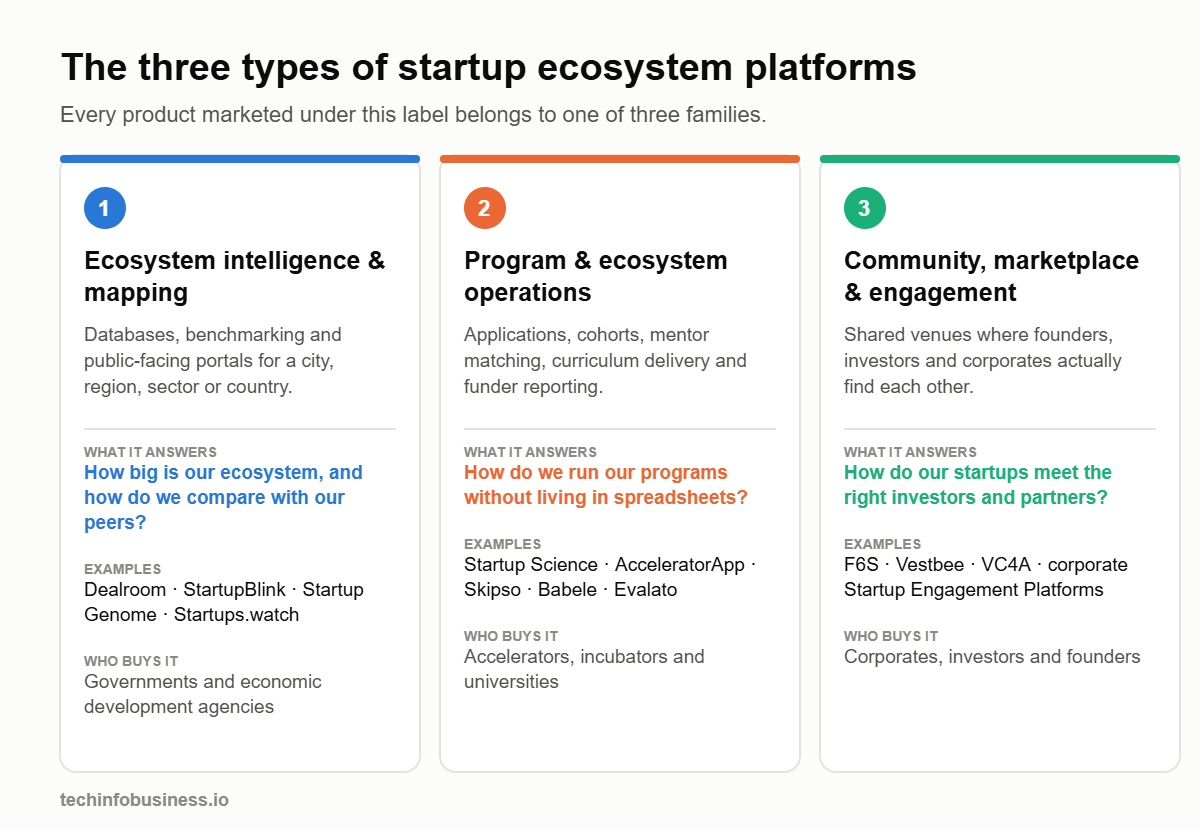
Ecosystem intelligence and mapping platforms
These are data products. They give you a structured, continuously maintained database of the startups, investors, funding rounds and support organisations in a defined scope, whether that scope is a city, a region, a country or a vertical. You use them to answer questions of measurement and comparison: how many active startups do we have, how much capital entered the ecosystem this year, how do we rank against comparable cities, which sectors are growing, and where are the visible gaps.
Dealroom’s Ecosystem Platform is the clearest example of the model. Dealroom describes these as dedicated startup databases focused on specific sectors, cities, regions or countries, running on its own underlying database and technology. Clients run searches across startup data, open detailed company profiles, look up investors, and give policymakers a read on the local tech climate. Crucially, Dealroom positions it as a fully managed solution, meaning the client does not need an internal data team to keep it current, and it includes a matching function so companies can find partners, clients and suitable investors rather than only being counted.
StartupBlink operates in the same family but leans harder into benchmarking and research. Its Global Startup Ecosystem Index ranks more than 1,500 ecosystems worldwide, drawing on over a hundred partner ecosystem organisations and publishing city-level case studies alongside the rankings. Its database holds more than 200,000 startups, it works with over a hundred governments, multilateral organisations and corporate startup programs, and its client list includes the United Nations Development Programme, Enterprise Singapore, Siemens, IBM, Boston Consulting Group and McKinsey. Alongside the index it sells ecosystem development support, public portals for local startups, corporate innovation services and policy advisory.
Startup Genome sits adjacent, functioning less as self-serve software and more as an ecosystem development organisation that combines research with advisory work for governments building toward globally competitive hubs. Startups.watch shows what a single-market version looks like, delivering Turkish startup ecosystem intelligence with investor profiles, deal records, portfolios, and coverage of accelerators, incubators and technoparks.
The right buyer for this family is anyone whose core problem is evidence. If you need to justify a budget, attract foreign investment, publish an annual ecosystem report, or show a ministry that an intervention worked, this is your category.
Program and ecosystem operations platforms
These are workflow products. They run the machinery of entrepreneurial support organisations, and their value is measured in staff hours recovered and reporting deadlines met rather than in insight generated.
The functional scope is consistent across vendors. Applications arrive through customisable forms and get scored and shortlisted. Selected founders are onboarded into cohorts. Milestones and KPIs are tracked per company and per stage. Mentors are matched to startups, ideally algorithmically rather than by a program manager cross-referencing two spreadsheets at midnight. Curriculum and learning content is delivered with assignments and progress tracking. Alumni relationships persist after demo day. And everything rolls up into reporting that satisfies whoever funds the program.
Startup Science is the most expansive current example, marketing itself as an operating system that unifies the ecosystem into one system linking founders, accelerators, mentors, investors and service providers. Its modules cover program management for applications, cohorts and alumni workflows, an academy with lifecycle-timed learning paths and certifications, a mentorship engine handling algorithmic matching, scheduling and progress tracking, capital access tooling including a grant finder, investor directory and AI-assisted grant writing, a marketplace with more than four hundred curated deals, and analytics covering cohort benchmarking and sponsor return on investment. It reports serving over 150 entrepreneurial support organisations and 88,000 startups across more than forty countries.
AcceleratorApp covers similar ground with end-to-end accelerator and incubator management, mentor matching, progress tracking and customisable workflows. Skipso markets directly into the accelerator and incubator use case. Babele takes a more methodological angle, emphasising collaborative business planning, project management, impact measurement and community engagement, which makes it a frequent choice for social impact and development-funded programs. Evalato is narrower and deeper, automating application intake and selection with customisable forms and real-time analytics, and is often bought by organisations that only need the front of the funnel solved. Teachfloor approaches the same buyer from the learning side, built around cohort-based learning modules with group projects, peer reviews, discussion forums and white-label branding.
Many accelerators also assemble this stack from general-purpose tools, running Notion, Asana or Monday for internal tracking, HubSpot or Salesforce as a founder CRM, and Slack plus Google Meet for community and delivery. That approach is cheap to start and expensive to maintain, and the pain of holding it together is the single most reliable trigger for a platform purchase.
Community, marketplace and corporate engagement platforms
The third family is network-first. Rather than giving one organisation a private tool, these platforms create a shared venue where many parties transact.
F6S is the best-known, operating as a large founder-facing network for programs, deals and applications, and it has become a de facto starting point for many founders looking for accelerators. Vestbee positions itself as an all-in-one platform connecting startups with VC funds, angels, accelerators and corporates, bundling community, infrastructure and tooling. VC4A runs its Global Startup Ecosystem as a digital accelerator, describing itself as the first and largest of its kind and supporting around a thousand companies from ninety countries each year, which is a structurally different model from software you license and populate yourself.
On the corporate side, this family overlaps with a category Gartner tracks formally as Startup Engagement Platforms. The buyer there is a large enterprise that needs to scout startups, run pilots and manage the pipeline from first contact to procurement, which is a different problem from running a twelve-week cohort. Strategy Tools illustrates yet another adjacent variant, partnering with innovation agencies, ministries, business schools, governments, banks and development finance institutions to build long-horizon ecosystem programs where the methodology matters as much as the software.
Who uses these platforms and why
Governments and economic development agencies buy primarily for evidence and visibility. They need to benchmark their city or country, show progress to political stakeholders, attract investors and talent from outside, and target policy where the data says the gaps are. For them, a fully managed intelligence platform with a public-facing portal usually beats an operations tool, because they rarely run programs directly.
Accelerators, incubators and university entrepreneurship centres buy for operational relief and reporting. Their pain is concrete: hundreds of applications to screen in three weeks, mentors to match without embarrassing anyone, milestones to track across two or three simultaneous cohorts, and a funder or sponsor who wants outcome numbers in a format the spreadsheet cannot produce. Their category is operations, with reporting as the feature that closes the deal.
Corporates, investors and founders are the network buyers. Corporates want structured scouting and pilot management. Investors want higher-signal deal flow with consistent, structured company data rather than inbound decks. Founders want to find the right program, the right investor and the right service provider without cold outreach. These needs are served best by the marketplace and engagement platforms, and increasingly by operations platforms that expose an investor-facing layer on top of their cohort data.
Core features to look for
Data coverage, refresh cadence and public presentation matter most on the intelligence side. Ask how the data is sourced, how often it updates, what percentage of your local companies the vendor can already identify today rather than after onboarding, and whether the client or the vendor is responsible for maintaining accuracy. Then ask what the public-facing output looks like, because a portal you can embed, brand and point journalists and investors toward is often the actual deliverable your stakeholders care about.
On the operations side, the recurring evaluation criteria across buyer’s guides are application and cohort management, milestone and progress tracking, mentor matching and engagement, curriculum delivery, and reporting and analytics. Add multi-cohort support if you run parallel or rolling programs, and check the realistic onboarding timeline, because a platform that takes a full quarter to configure is useless if your next intake opens in five weeks.
Reporting deserves its own scrutiny regardless of category. The question is not whether the platform has a dashboard but whether it can produce the specific report your funder, ministry or sponsor demands, in the format they demand, without a data export and a week of manual cleanup. Ask to see a real sponsor or grant report generated by the system. Vendors who can show one immediately are a different class of product from those who promise it is configurable.
Integrations are the last practical filter. Almost nobody replaces their entire stack at once, so the platform needs to coexist with the CRM, calendar, video and communication tools your team already lives in.
What these platforms cost
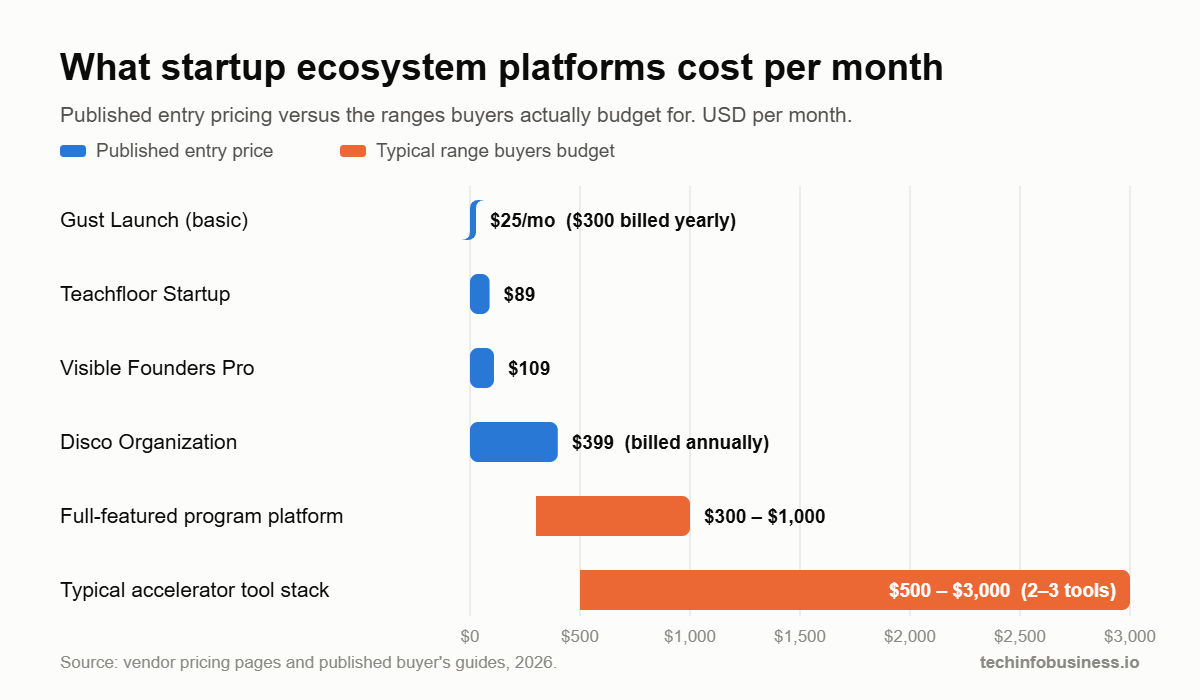
Public pricing in this market is patchy, but enough is visible to set expectations. Full-featured program management platforms generally land between roughly three hundred and one thousand dollars per month, varying with cohort size and module count. Disco’s Organization plan is listed at $399 per month billed annually. Teachfloor’s Startup tier starts around $89 per month with full-feature access quoted individually. Visible’s Founders Pro plan runs about $109 per month, while its investor-side plans span roughly two hundred to over a thousand dollars monthly. Gust Launch sits far lower at around three hundred dollars per year for basic use. Enterprise intelligence platforms such as Dealroom’s Ecosystem Platform and StartupBlink’s ecosystem development engagements are quoted rather than listed, and generally involve annual contracts closer to consulting budgets than software budgets, because managed data and research work is bundled in.
The number worth remembering is the total, not the line item. Most accelerators end up spending somewhere between five hundred and three thousand dollars a month once you count the two or three tools they run in parallel. That figure is the real benchmark for any consolidation pitch you hear, and it is the honest basis for evaluating whether a single platform saves money or simply adds a fourth subscription.
How to choose the right platform for your ecosystem
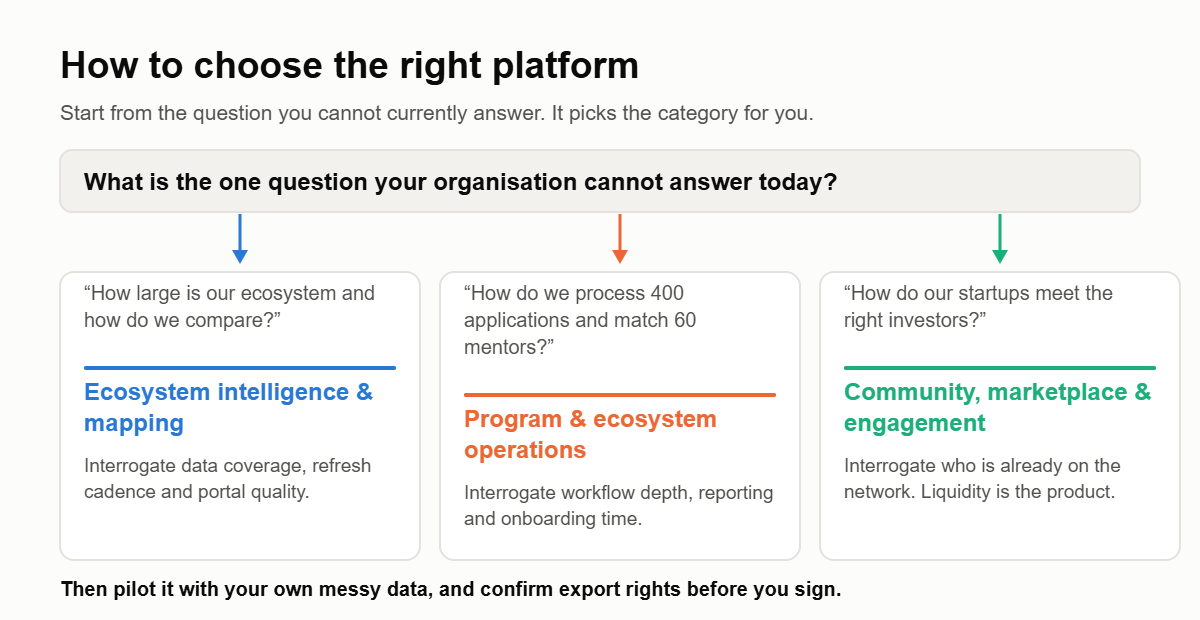
Start by writing down the question you cannot currently answer, and be specific. If it is “how large is our ecosystem and how do we compare to our regional peers,” you need an intelligence platform and you should be interrogating data coverage and portal quality. If it is “how do we process four hundred applications and match sixty mentors without burning out two staff members,” you need an operations platform and you should be interrogating workflow depth and onboarding time. If it is “how do our startups meet the right investors and corporates,” you need a network, and the relevant question is whether the platform already has the members you want, because network products are worth exactly the liquidity they bring.
Then check what you already have. Many organisations discover that the local ecosystem is already partially mapped by a national or regional platform, or that their existing CRM handles sixty percent of what an operations tool would do. Buying the missing forty percent as a point solution such as an application and evaluation tool is frequently the better first move than a platform migration.
Run a real pilot with real data. Load an actual past cohort or an actual slice of your local company list and see what the system does with it. Demos are built on clean data; your data is not clean, and the gap between the two is where implementation projects fail.
Finally, decide who owns the data and what happens at renewal. Managed platforms are attractive precisely because the vendor maintains the dataset, but that convenience means your ecosystem’s map may live in someone else’s system. Clarify export rights before signing, not eighteen months later.
Common mistakes ecosystem builders make with these platforms
The most expensive mistake is buying a platform instead of building an ecosystem. Software makes existing activity visible and manageable; it does not generate founders, capital or mentors. Fragmented digital infrastructure is a genuine problem, but so are insufficient mentorship, constrained capital access, regulatory friction and low cross-organisation visibility, and only the last of those is meaningfully fixed by a purchase.
The second is buying for the report rather than the user. Platforms selected purely to satisfy a funder’s reporting template tend to be quietly abandoned by program staff, at which point the data going in stops being trustworthy and the reports become fiction.
The third is underestimating the population and maintenance burden. An ecosystem map is only credible if it is current, and a dashboard nobody updates is worse than no dashboard because it invites wrong decisions with false confidence. If you cannot assign a named owner for data upkeep, choose a fully managed product and pay the premium.
The fourth is treating vendor-published ecosystem rankings as neutral scorekeeping. Indexes and benchmarks are genuinely useful directional tools, and the organisations producing them do serious methodological work, but they are also marketing assets for companies that sell ecosystem development services. Use them as one input among several rather than as the target you optimise toward.
Frequently asked questions
Is a startup ecosystem platform the same as accelerator management software?
Accelerator management software is one subtype, sitting in the operations family. It handles applications, cohorts, mentors, curriculum and reporting for a single organisation. A startup ecosystem platform may mean that, or it may mean a region-wide intelligence database, or a multi-party network. Always ask a vendor which of the three they are, because their answer determines whether their product solves your problem.
Do we need one if we only run a single small program?
Usually not immediately. A single annual cohort of ten companies can be run credibly on a form tool, a spreadsheet and a shared drive. The tipping point arrives with parallel cohorts, application volume that exceeds manual screening, mentor matching at scale, or a funder demanding structured outcome reporting.
Can one platform cover both ecosystem mapping and program operations?
Increasingly yes in marketing, and partially yes in practice. Platforms like Startup Science deliberately span program management, mentorship, capital access and analytics in one system, and intelligence vendors like Dealroom add matching and network features on top of their databases. Just verify depth on the side that matters most to you, since almost every product is clearly stronger in its family of origin.
What should we look at before booking demos?
Define the unanswerable question, audit what your existing tools already do, confirm your real total monthly spend across current subscriptions, and identify the one report you must be able to produce. Walking into a demo with those four things turns a sales conversation into an evaluation.